Today the National Trust for Historic Preservation released their 2009 list of the Most Endangered Historic Sites in the United States. On the list is Miami Marine Stadium. To learn more about the stadium, or to help preserve this landmark, visit the Friends of Miami Marine Stadium's website, http://www.marinestadium.org/.
Should we Floridians be proud or ashamed that Florida landmarks make this list so often? In 2008, it was Vizcaya and Bonnet House. In 2007, it was Hialeah Park Race Course. We skipped 2006, but there was the Belleview Biltmore Hotel in 2005.
Tuesday, April 28, 2009


Monday, April 27, 2009

Tuesday, April 14, 2009
The Old Spanish Trail's Zero Marker
The Old Spanish Trail is not really Spanish, nor is it particularly old, at least for St. Augustine. The "trail" began in 1915 as a transcontinental highway for automobiles, connecting St. Augustine in the east to San Diego in the west. The Old Spanish Trail Association began in Mobile, Alabama, where they saw the commercial benefit of having an east/west highway connecting the new north/south Jackson and Dixie highways. Thus, the Old Spanish Trail began in a city known for its French heritage.
These new highways brought automotive tourists and their money to the communities along the roadways. During World War I, advocates of the Old Spanish Trail (and other national highways) promoted its importance as a military road, vital for national security and defense, anticipating Eisenhower's Interstate Highway system by several decades. In the 1920s, Harral B. Ayres, the Old Spainish Trail Association's director, encouraged the notion that the highway followed old Spanish roads, using the romance of the past to promote tourism.
The terrain the highway was to cover in the southeastern United States hampered construction - bridges were needed over the many rivers and swamps of the coastal South. The Old Spanish Trail was not completed until 1929, an event marked by a three-day celebration in St. Augustine, and the dedication of this commemorative marker (which since has been moved twice).

Each year, on the last weekend of April and the first weekend of May, Crestview, Florida, holds the Old Spanish Trail Festival. This year will be the event's 53rd anniversary, and is only 11 days from now!
-----------------
The Story of the Old Spanish Trail, by Harral B. Ayres (Old Spanish Trail Centennial)
These new highways brought automotive tourists and their money to the communities along the roadways. During World War I, advocates of the Old Spanish Trail (and other national highways) promoted its importance as a military road, vital for national security and defense, anticipating Eisenhower's Interstate Highway system by several decades. In the 1920s, Harral B. Ayres, the Old Spainish Trail Association's director, encouraged the notion that the highway followed old Spanish roads, using the romance of the past to promote tourism.
The terrain the highway was to cover in the southeastern United States hampered construction - bridges were needed over the many rivers and swamps of the coastal South. The Old Spanish Trail was not completed until 1929, an event marked by a three-day celebration in St. Augustine, and the dedication of this commemorative marker (which since has been moved twice).

Each year, on the last weekend of April and the first weekend of May, Crestview, Florida, holds the Old Spanish Trail Festival. This year will be the event's 53rd anniversary, and is only 11 days from now!
-----------------
The Story of the Old Spanish Trail, by Harral B. Ayres (Old Spanish Trail Centennial)
Monday, April 13, 2009
Welcome to the Waterdome Redux

I finally had a chance to see the Waterdome at Florida Southern College in action, nearly a year and a half after its rebirth! It was bluer and smaller than I expected, although a nearby sign detailed a schedule of when the fountain is off, at partial power, and full blast. We were there on a Saturday afternoon -- at least half the people we saw were like us - wandering around staring at the Frank Lloyd Wright buildings. Even though it has been a cool spring season, there's enough concrete and metal on that part of the campus to make a water feature like the fountain a welcome sight.
Welcome to the Waterdome (October 2007)
Frank Lloyd Wright Water Dome / Florida Southern College
Wednesday, April 08, 2009
Rodriguez-Avero-Sanchez House in St. Augustine

Here is the Rodriguez-Avero-Sanchez House at 52 St. George Street in St. Augustine. The first rooms of this house were built sometime around 1760 or 1761. In 1761 it was the home of a former member of the Spanish garrison, a Galician named Fernando Rodriguez. When he died in 1762, Antonia de Avero inherited the property. Over the years, the house passed from one owner to another - some British, some Spanish, some members of the Avero family, some not. Between 1791 and 1802, Juan Sanchez built the two-story coquina-block portion of the house that fronts onto St. George Street today.
The National Park Service's Historic American Building Survey documented the Rodriguez-Avero-Sanchez House in the 1960s, providing a detailed history of the house and a description of the building. The HABS documentation includes 1960 photographs of the house before its restoration as well as 1965 "after" images.
The 1965 images of the Rodriguez-Avero-Sanchez House were taken by Jack Boucher, whose career as a photographer for the Historic American Building Survey is featured in the Spring 2009 issue of Common Ground. Common Ground is a free publication of the National Park Service.
Tuesday, March 31, 2009
Cat Statue

Back in 1991, I visited Key West for the first time, and one highlight of the trip was the Hemingway House. The tour guide casually pointed out a ceramic statue sitting on top of a cabinet, a gift from from Pablo Picasso to Ernest Hemingway. Years later I heard that the statue had been stolen, which honestly wasn't surprising considering it was a cool Picasso statue just sitting on a cabinet in a house.
Years later, while going through boxes of old photos (oh, the pre-digital days), we came across this picture from that 1991 trip. According to the Hemingway House museum's website, the cat was found in a box in the 1970s, and Hemingway's wife said that it was a gift from Picasso to Hemingway. The two men had become friends when living in Paris in the 1920s. The statue was stolen during or shortly after a house tour in November 2000, and recovered a month later when the thief tried to use it as a deposit for a small boat. Unfortunately, the statue was badly damaged. The statue now on display in the house museum is a replica.
(Sources included the Hemingway House website, the Dec. 11, 2000 Miami Herald, and the Jan. 26, 2001 Palm Beach Post)
Thursday, March 26, 2009
A Florida Fresh Market

Primed by promises of fresh, local produce, I visited a local fresh market this week for the first time in a long while. I surmised that since a lot of vegetables are grown in Florida, that a fresh market in Florida would have little room for foreign fruit. So I was disappointed to see Chilean grapes and California avocados.
I acknowledge my hypocrisy in expecting local produce in Florida, a state whose vast agricultural economy is based on selling to people who live elsewhere. For centuries, Florida farmers have made their livings by selling oranges and green beans and strawberries to people far, far away. Pioneering farmers loaded citrus onto steamboats and trains so that hotels in New York City might serve sectioned fruit to their guests. Thousands of men were lured to Florida by the promise of a better life as a gentleman farmer, with ten acres in the country and a house in town.
Indeed, there were several local products available at the Oldsmar Fresh Market that I do not see at my local Publix or Wal-Mart Supercenter. There were fresh breads from a local bakery, fresh Gulf seafood, and honey from local bees. Of course there were Florida strawberries, and Ruskin tomatoes. There was a table of Florida citrus, and not the shiny perfect fruit that gets mailed away in gift baskets, but the duller, lumpier fruit Floridians keep for themselves because it tastes so good. Here were the Florida grapefruit, the Temple orange, and the Honey Murcott. The Temple and the Honey Murcott oranges are both tangors, crosses between tangerines and sweet oranges. The Temple orange gave its name to the city of Temple Terrace, where larges groves of the fruit once grew. The Honey Murcott orange is named after Charles Murcott Smith who first planted groves of this variety nearby in Pinellas County.

"Home cooking: Surviving for a week on locally grown food" (St. Petersburg Times, October 24, 2008)
Wednesday, March 25, 2009
Kate DiCamillo
Today is author Kate DiCamillo's birthday (Happy Birthday!). Although her more recent books - The Miraculous Journey of Edward Tulane, The Tale of Despereaux, the Mercy Watson series, and the forthcoming The Magician's Elephant - don't offer much proof of it, she is a Florida writer.
Born in the north, Kate experienced poor health as a child. Her doctor recommended the time-honored cure of moving to Florida, and she came to Clermont with her mother and brother. Her first novel, Because of Winn-Dixie, is set in North Florida, although I've pondered whether the setting is integral to the plot. I think the story could be set elsewhere in the South just as easily. On her website, however, DiCamillo writes that the story arose at least in part from her homesickness for Florida during a cold Minnesota winter. Nor is her second book, The Tiger Rising, particularly dependent on its Florida setting for meaning. It does, however, incorporate the timeless Florida theme of new beginnings and second chances.
Born in the north, Kate experienced poor health as a child. Her doctor recommended the time-honored cure of moving to Florida, and she came to Clermont with her mother and brother. Her first novel, Because of Winn-Dixie, is set in North Florida, although I've pondered whether the setting is integral to the plot. I think the story could be set elsewhere in the South just as easily. On her website, however, DiCamillo writes that the story arose at least in part from her homesickness for Florida during a cold Minnesota winter. Nor is her second book, The Tiger Rising, particularly dependent on its Florida setting for meaning. It does, however, incorporate the timeless Florida theme of new beginnings and second chances.
Friday, February 27, 2009
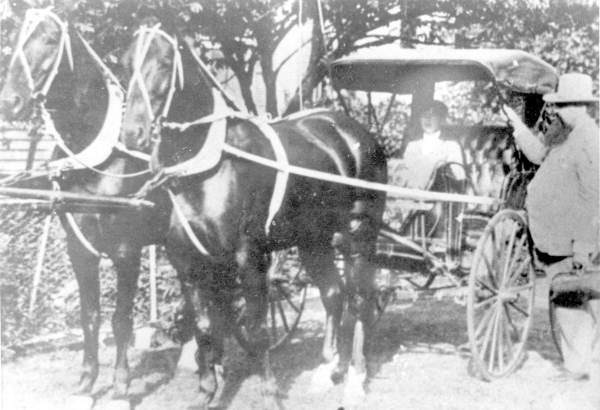
Hiram Hampton, Pistol Packing Doctor

(Florida State Archives)
Dr. Hiram J. Hampton owned and operated the Tampa Heights Sanitarium in the late nineteenth and early twentieth centuries, advertising his services "for the cure of CANCER, RUPTURE, SCROFULA and Kindred DISEASES, and all cases requiring SURGICAL ATTENTION. No Mercury Used In This Institution. Tape Worm Positively Removed." His wife Emma at times assisted as his nurse. The 1903 Transactions of the National Eclectic Medical Association of the United States recognize Dr. Hampton as member of the Eclectic Medical Examiming Board for Florida.
In Tampa today, Dr. Hampton is most widely known for the unique character of his and Emma's grave sites in Woodlawn Cemetery. The crypts are topped with at least life size seated statues of the couple, and local lore oft repeats the story that the Hamptons' backs are turned deliberately to the city.

Thursday, February 26, 2009
My, How You've Changed...
Tucked away on a side street off Ybor's Seventh Avenue is a white building with distinctive, large windows.

It's obviously old,
and looks like it might have been a church,
but now it's a nightclub.
Here are links to photographs of the building when it was the Clark Memorial Baptist Church and Baptist Goodwill Center -- back when it was much taller!
1947 Burgert Brothers photograph (church entrance)
1947 Burgert Brothers photograph (church with children in front)
Burgert Brothers photograph showing the side of the church as well (click on thumbnail image for larger view)

It's obviously old,
and looks like it might have been a church,
but now it's a nightclub.
Here are links to photographs of the building when it was the Clark Memorial Baptist Church and Baptist Goodwill Center -- back when it was much taller!
1947 Burgert Brothers photograph (church entrance)
1947 Burgert Brothers photograph (church with children in front)
Burgert Brothers photograph showing the side of the church as well (click on thumbnail image for larger view)
Subscribe to:
Posts (Atom)